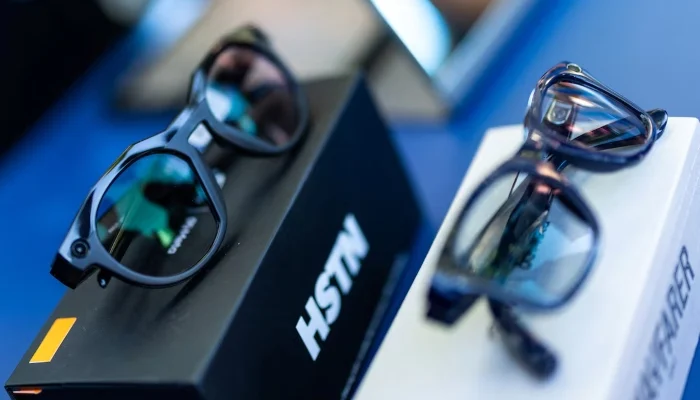
Additionally, Meta introduces the Vanguard, a new line of Oakley-branded eyewear designed for athletes. MENLO PARK: In an effort to build on the success of its Ray-Ban brand, one of the first consumer hits of the artificial intelligence age, Meta Platforms on Wednesday introduced its first consumer-ready smart glasses with an integrated display. Despite some demo issues, CEO Mark Zuckerberg received praise at Meta’s Connect event for showcasing the Meta Ray-Ban Display and a new wristband controller.
Zuckerberg said that Meta’s smart glasses, which have seen success, are the ideal means for people to pursue the AI promise of “superintelligence.” “Glasses are the ideal form factor for personal superintelligence, because they let you stay present in the moment while getting access to all of these AI capabilities that make you smarter, help you communicate better, improve your memory, improve your senses, and more,” Zuckerberg stated. For simple functions like notifications, the new Display glasses feature a tiny digital display in the right lens. They will go on sale in stores on September 30 and cost at $799. A wristband that converts hand gestures into commands, such answering calls and texts, is part of the package.
The announcement, which took place at Meta’s annual developer conference, Connect, at its headquarters in Menlo Park, California, is the company’s most recent effort to catch up in the fiercely competitive AI race. Although the social media behemoth has led the way in creating smart eyewear, it lags behind competitors like OpenAI and Alphabet’s Google in releasing sophisticated AI models. Zuckerberg has pledged to spend tens of billions of dollars on state-of-the-art AI technology and has started a Silicon Valley talent war to steal engineers from competitors. The new glasses are being released at a time when Meta is being criticized for how it handles child safety on social networking.
Whistleblowers revealed last month that academics were instructed not to investigate the negative impacts of virtual reality on youngsters, while Reuters claimed in August that Meta chatbots involved kids in contentious discussions about sex and racism. Sporty Oakley eyewear is available. On Wednesday, Meta also debuted the Vanguard, a $499 pair of Oakley-branded eyewear designed for athletes. The gadget has a nine-hour battery life and connects with fitness platforms like Garmin and Strava to provide real-time training statistics and post-workout reports. On October 21, it will be accessible.
Additionally, it upgraded its Ray-Ban line, which did not have an integrated display but now had a superior camera and nearly twice the battery life of the previous iteration, costing $379 instead of $299. Analysts believe the Display glasses could be a step toward the projected 2027 debut of Meta’s “Orion” spectacles, even if they do not anticipate big sales. Zuckerberg referred to the prototype that Meta unveiled last year as “the time machine to the future.” The presentation of the Display, according to Forrester analyst Mike Proulx, reminded him of Apple’s launch of a watch as a substitute for smartphones.
“Glasses are an everyday, non-cumbersome form factor,” he stated. According to him, Meta still needs to persuade consumers that the advantages outweighed the drawbacks, but “there’s a lot of runway to earn market share.” Existing features on all the devices include cameras, hands-free operation, Meta’s AI assistant, and livestreaming to the company’s social media accounts on Facebook and Instagram. Not all of Zuckerberg’s demonstrations of the new Display glasses went according to plan; for example, a call to the glasses did not connect. When Zuckerberg said, “I don’t know what to tell you guys,” “I keep on messing this up.” The audience gave a cheer of approval.
“It’s great value for the tech you’re getting,” Jitesh Ubrani, research manager for IDC’s Worldwide Mobile Device Trackers, said of the glasses. However, the software must catch up. “Until we get there, it’s not really a device that the average consumer might know about or care to purchase,” Ubrani stated. According to IDC, demand for the less expensive Ray-Bans that Meta and Ray-Ban owner EssilorLuxottica produce will drive a large portion of the growth in global shipments of augmented reality/virtual reality headsets and display-less smart glasses, which are expected to rise by 39.2% to 14.3 million units in 2025.