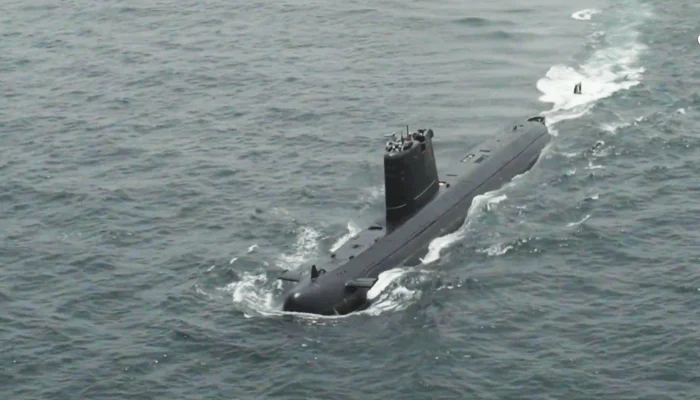
Islamabad to Receive Eight Hangor-Class Submarines Under $5 Billion Deal with China
The Pakistan Navy is set to deploy its first Chinese-designed submarine next year, according to the country’s top naval officer. The move strengthens Beijing’s efforts to counter India’s regional influence and extend its reach toward the Middle East.
Admiral Naveed Ashraf told China’s Global Times that the project for eight Hangor-class submarines, scheduled for delivery by 2028, is “progressing smoothly.” He said the new submarines will significantly enhance Pakistan’s naval operations across the North Arabian Sea and the Indian Ocean.
The announcement comes after Pakistan Air Force used Chinese-made J-10 fighter jets in May to shoot down Indian Air Force aircraft, including France’s Rafale jets. The clash between the two nuclear-armed nations drew global attention and renewed debate over the performance of Western versus Chinese military technology.
Under the $5 billion submarine agreement, the first four diesel-electric attack submarines will be built in China, while the remaining four will be assembled in Pakistan to boost local defense manufacturing capacity. Three submarines have already been launched from a shipyard on China’s Yangtze River in Hubei province.
“Chinese platforms and equipment have proven reliable, technologically advanced, and well-suited to Pakistan Navy’s needs,” Admiral Ashraf said. “As warfare becomes more technology-driven, the Navy is focusing on unmanned systems, artificial intelligence, and advanced electronic warfare—areas where we aim to deepen cooperation with China.”
According to the Stockholm International Peace Research Institute, Pakistan remains China’s largest arms buyer, accounting for more than 60% of Beijing’s total weapons exports between 2020 and 2024.
Strategic Expansion Through the Arabian Sea
Beyond defense cooperation, China has invested billions in infrastructure linking its western Xinjiang region to Pakistan’s deep-water port of Gwadar through the 3,000-kilometer China-Pakistan Economic Corridor (CPEC). The CPEC, a core part of President Xi Jinping’s Belt and Road Initiative, is designed to secure a vital energy route from the Middle East while avoiding the vulnerable Straits of Malacca.
“This partnership goes beyond military hardware,” Admiral Ashraf noted. “It reflects shared strategic goals, mutual trust, and a partnership built over decades. In the next decade, we expect deeper collaboration across shipbuilding, training, research, technology sharing, and industrial development.”