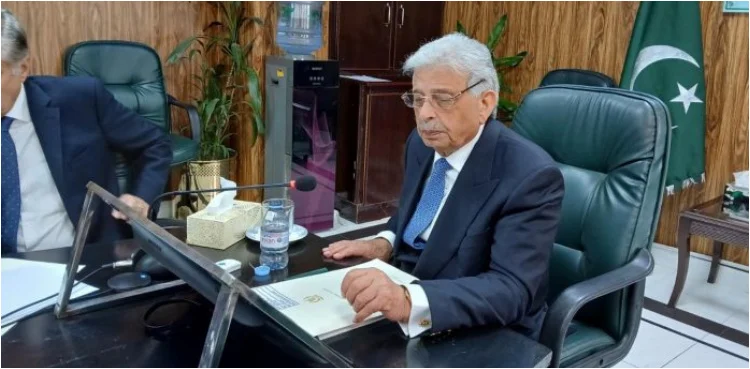
ISLAMABAD: The Ministry of National Food Security & Research (MNFS&R) has reaffirmed its steadfast dedication to the long-term growth of Pakistan’s olive industry, utilizing cutting-edge genetic technology and fresh international collaborations to increase production and enhance plant quality. The federal minister for national food security presided over a high-level meeting in Islamabad on the Molecular Assessment of True-to-Type Characteristics of Olive Varieties and Olive Sector Development in Pakistan. During the meeting, officials reiterated their commitment to the sustainable development of Pakistan’s olive sector, characterizing it as a crucial component of rural livelihoods, import substitution, and climate resilience. The minister called the recently conducted 7th Olive Gala 2025 a significant step in advancing olive farming in Pakistan.
According to him, the government wanted to enhance the whole value chain, from nurseries and orchards to processing and marketing, while increasing the number of olive trees in appropriate agroclimatic zones. Officials stated during the meeting that Pakistan has already made significant strides toward turning marginal and uncultivated land into fruitful olive orchards. Improving the nursery system to guarantee farmers receive high-quality, true-to-type plants is the next goal, they added. The use of molecular and DNA-based fingerprinting to confirm and validate olive types was one of the meeting’s main topics. According to officials, these methods would help guarantee varietal purity, boost producers’ confidence, and encourage research and innovation in Pakistan.
Subject to the availability of reference parent material, the National Institute for Genomics and Advanced Biotechnology (NIGAB) affirmed that it possesses the technological capability to conduct molecular testing using cutting-edge facilities. The ministry revealed plans to expand scientific cooperation with Italy, one of the top producers of olives worldwide, in a major step. As part of the OliveCulture Scale-Up Project, the Ministry announced the start of a Memorandum of Understanding (MoU) between NIGAB and the University of Bari Aldo Moro, Italy, facilitated by CIHEAM Bari. Access to globally recognized molecular (SSR) profiles of olive types, parent genetic material, collaborative research projects, and specialized training for Pakistani scientists and technicians are all made possible by this partnership.
Additionally, Italian partners have contributed assistance in developing plant certification procedures, confirming Pakistan’s olive genetic resources, and researching native wild species, such as Olea europaea subspecies cuspidata, as well as farmed olives. Future crops must closely match the local climate and environment, according to the minister’s directive. This strategy will include comprehensive agronomic and climate studies, as well as the pilot introduction of Tunisian olive cultivars that are better suited to hotter climes in the Cholistan region.
Additionally, Phase-III of the Promotion of Olive Cultivation on Commercial Scale in Pakistan would be developed and submitted for approval, according to the Ministry. To further speed up the expansion of the olive industry, this phase will include new funding methods, public-private partnerships, match grant programs, carbon credit opportunities, and enlarged pilot farms.