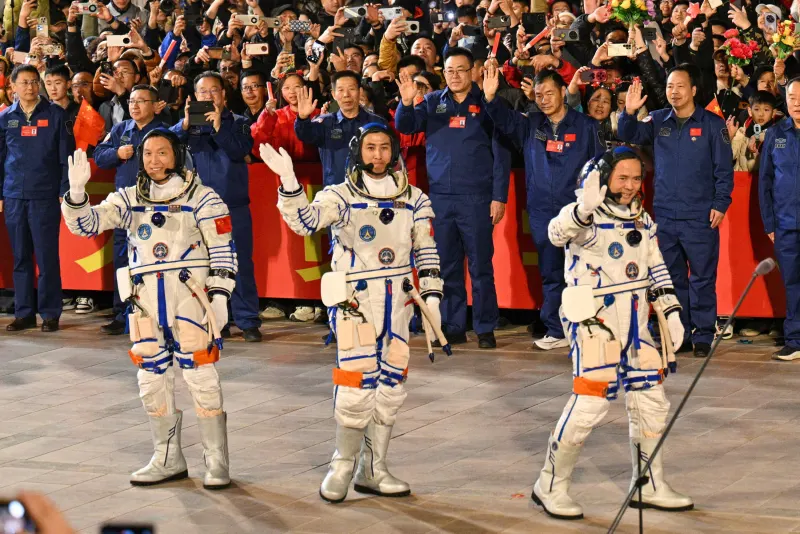
A team of three Chinese astronauts, including the country’s youngest ever, arrived at the Tiangong space station along with four lab mice early Saturday morning.
The Shenzhou-21 spacecraft docked at 3:22 am, just three and a half hours after lifting off from the Jiuquan Satellite Launch Center in northwest China using a Long March-2F rocket.
Tiangong space station, which hosts teams of three astronauts that rotate every six months, is a key project in China’s space program. China is investing billions of dollars to catch up with space powers like the United States and Russia.
China plans to send astronauts to the Moon by the end of this decade and build a lunar base in the future.
The crew is led by mission commander Zhang Lu, accompanied by 32-year-old flight engineer Wu Fei, the youngest Chinese astronaut on a space mission, and payload specialist Zhang Hongzhang, aged 39.
The astronauts said goodbye to their colleagues and families at the Gobi Desert launch base, with a band playing a patriotic song.
Commander Zhang Lu expressed full confidence in his team’s success, saying, “We will report back to our motherland and its people with complete success.”
First-time astronaut Wu Fei shared that he felt “incomparably lucky” to be part of this mission.
Joining the astronauts are four mice—two male and two female—for China’s first in-orbit experiments on rodents.
China’s Space Dream
China’s space program is the third in history to send humans into orbit, following the United States and the former Soviet Union.
Under President Xi Jinping, China has accelerated its “space dream,” landing the Chang’e-4 probe on the Moon’s far side in 2019 and a small robot on Mars in 2021.
Last Thursday, the China Manned Space Agency announced several “crucial upcoming tests” to prepare for the 2030 Moon ambitions.
The Shenzhou-21 crew will carry out spacewalks, install anti-debris shields outside the Tiangong station, and lead popular science education activities to inspire new space talent in China and around the world.
Since 2011, China has been excluded from the International Space Station after a U.S. ban on NASA collaboration with Beijing. China has responded by seeking partnerships with other countries, and in February signed an agreement with Pakistan to recruit its first foreign astronauts.
Keywords: China space station, youngest astronaut, Tiangong, Shenzhou-21, lunar mission, Long March-2F rocket, space experiment mice, Chinese space program, Wu Fei, Zhang Lu, space education, Mars robot, Chang’e-4 Moon probe, astronaut recruitment, anti-debris shield, spacewalk, International Space Station, CMSA, Moon base.