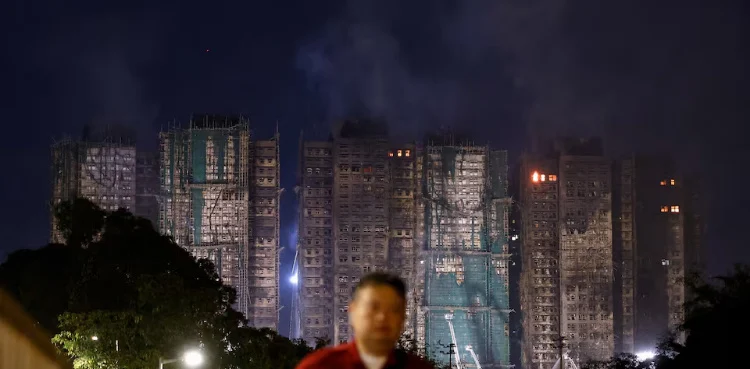
The fire that tore through the Wang Fuk Court apartment complex in Tai Po’s northern area had been largely confined by firefighters. The estate was covered in green mesh and bamboo scaffolding as it underwent repairs. For over a day, rescuers struggled to reach occupants who were thought to be trapped on the top levels despite the extreme heat and dense smoke. On Thursday night, footage saw firefighters using spotlights to explore the burned remnants of the towers. Authorities stated at a press briefing early on Friday that they anticipated the fire being completely put out in the next few hours.
Outside one of eight shelters holding 900 people, a distressed woman with her daughter’s graduation photo looked for her child. The 52-year-old, who just provided her last name, Ng, cried and said, “She and her father are still not out yet.” “They didn’t have water to save our building.” Two directors and an engineering consultant from Prestige Construction, a company hired to maintain the buildings, were taken into custody by the police. Those detained were suspected of manslaughter for utilizing hazardous materials, according to the police. Police Superintendent Eileen Chung stated, “We have reason to believe that the company’s responsible parties were grossly negligent, which led to this accident and caused the fire to spread uncontrollably, resulting in major casualties.”
Repeated requests for comment were not answered by Prestige. The government also stated that during a raid on the company’s office, police confiscated three cell phones, fourteen computers, a list of personnel, and bidding paperwork.
WORST FIRE SINCE 1948
As of midnight on Thursday, Hong Kong’s emergency responders reported that the confirmed death toll had increased to 83. This made it the deadliest fire in Hong Kong since a warehouse fire in 1948 claimed 176 lives. Early on Thursday morning, the government said that 279 persons were missing; however, the number has not been updated in a whole day.
More than 4,600 people lived in the eight blocks of the densely populated complex of 2,000 apartments in the financial center, which is having trouble overcoming ongoing shortages of affordable housing. Additionally, police reported that during a year-long maintenance project, they discovered foam stuff sealing windows on one unaffected structure. As a safety precaution, the city’s development department has talked about gradually switching out bamboo scaffolding with metal scaffolding. According to official broadcaster CCTV, Chinese President Xi Jinping called for a “full-out effort” to put out the fire and reduce lives and losses. Both the Chinese Communist Party and the Hong Kong government’s leadership acted swiftly to demonstrate how much they valued a tragedy that was perceived as a possible test of Beijing’s control over the semi-autonomous area.
Despite attempts to strengthen political and national security control, Hong Kong’s exorbitant real estate prices have long been a source of unhappiness, and the tragedy may increase discontent with the government. “He is dead in room 1 on the 27th floor.” Residents of certain towers and rooms were included in a Google document that was linked to an online app that displayed reports of missing persons. It has descriptions like “one boy and one girl,” “Mother-in-law in her 70s, missing,” and “Rooftop: 33-year-old male.” “27th floor, room 1: He is dead” is all that needs to be read. The information in the app could not be independently verified by News Channel.
The Grenfell Tower disaster in London, which claimed 72 lives in 2017, has been compared to this incident. The government, the construction sector, and companies that installed combustible cladding on the exterior were all held accountable for the incident. High-rise housing complexes are strewn throughout Hong Kong, one of the most populous cities in the world. About 300,000 people live in Tai Po, a well-established suburban area close to the Chinese mainland border. According to property agency websites, the complex, which has been occupied since 1983, is a lifeline for middle-class families in the city because it is part of a government-subsidized house ownership program.