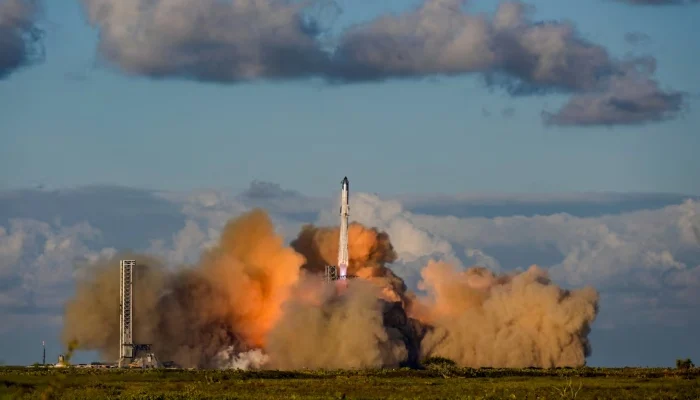
The massive SpaceX Starship rocket lifted off from the company’s South Texas launch site just after 6:25 p.m. local time on Monday, marking another milestone for Elon Musk’s ambitious space program.
A Super Heavy booster carried the Starship spacecraft during its 11th test flight, drawing cheers from SpaceX engineers watching the launch live. The booster safely landed in the Gulf of Mexico, while the Starship upper stage continued through space, completing mission tests similar to its successful August flight.
After releasing mock satellites, the upper stage splashed into the Indian Ocean about an hour after liftoff. No recovery was planned for this portion of the rocket.
NASA aims to use Starship, the world’s largest and most powerful rocket, to return astronauts to the Moon. The spacecraft is also central to Musk’s long-term vision of sending humans to Mars.
Speaking before launch, Musk said he preferred watching the liftoff from outside, calling the experience “much more visceral” than observing from indoors.
This mission is expected to be the final flight for the current Starship prototype series. SpaceX plans to debut Version 3 on the next launch.
While SpaceX has celebrated recent successes, previous missions included dramatic explosions that raised concerns about whether Starship can meet NASA’s tight lunar timeline.
The Artemis program aims to return humans to the Moon, while China is advancing its own crewed lunar mission, targeting 2030. U.S. leaders have urged NASA to accelerate progress, and SpaceX’s Starship is key to meeting these goals. The company holds a multibillion-dollar federal contract to develop a modified lunar lander version of Starship.
Second Space Race Concerns
The Artemis III mission is scheduled for mid-2027, but a NASA safety panel has warned it could face significant delays. Former NASA administrator Jim Bridenstine recently told a Senate panel that the U.S. may struggle to beat China’s projected lunar timeline.
NASA’s acting administrator Sean Duffy emphasized that the U.S. will maintain leadership in space, asserting, “America has led in space in the past, and we are going to continue to lead in space in the future.”
Earlier Starship tests often ended in explosions, including incidents over the Caribbean and during ground tests. Musk has noted that developing a fully reusable orbital heat shield is one of the program’s greatest challenges, comparing it to the nine-month refurbishing process of the Space Shuttle heat shield.
Another critical test is proving Starship can be refueled in orbit with super-cooled propellant—essential for deep-space missions but not yet achieved. NASA’s Aerospace Safety Advisory Panel has highlighted the risks of this orbital refueling step, with member Paul Hill calling the timeline “significantly challenged.”